Cape Crow
Corvus capensis
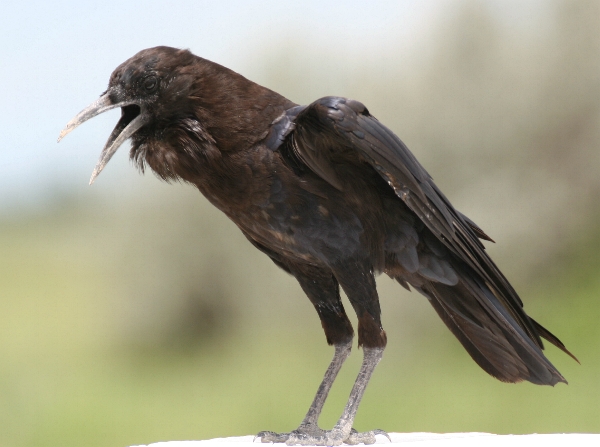
The Cape crow or black crow is slightly larger than the carrion crow and is completely black with a slight gloss of purple in its feathers. It also has proportionately longer legs, wings, and tail, and has a much longer, slimmer bill that seems to be adapted for probing into the ground for invertebrates. The head feathers have a coppery-purple gloss and the throat feathers are quite long and fluffed out in some calls and displays. Source
Where is the Cape Crow now?
In the last 8 weeks it was recorded 51 times across 5 areas (each area is a 5 degree square).
See the Cape Crow on the live map
Get an email when the Cape Crow arrives near you
When does the Cape Crow arrive?
The week it was first heard regularly in each region, after at least six weeks away. Dates differ from south to north, so a region has a range.
| Region | First arrival | Last arrival | Typical peak | Areas |
|---|---|---|---|---|
| Africa | 29 June 2026 | 29 June 2026 | 6 July 2026 | 1 |
Download every area as CSV · Review these arrival dates (researchers, ORCID sign-in)
Arriving at the same time in Africa
- Common Starling Sturnus vulgaris
- Little Owl Athene noctua
- Whiskered Tern Chlidonias hybrida
- White-necked Raven Corvus albicollis
- Red-Knobbed Coot Fulica cristata
- Collared Sunbird Hedydipna collaris
- Graceful Prinia Prinia gracilis
- Dunnock Prunella modularis
Every arrival in Africa, month by month
Related species
- Rook Corvus frugilegus
- American Crow Corvus brachyrhynchos
- Eurasian Jackdaw Corvus monedula
- Common Raven Corvus corax
- Fish Crow Corvus ossifragus
- Hooded Crow Corvus cornix
- Carrion Crow Corvus corone
- House Crow Corvus splendens
Figures are effort corrected and come from automatic sound identification, which makes mistakes. How this is measured · How it compares with human observers