Spring Peeper
Pseudacris crucifer
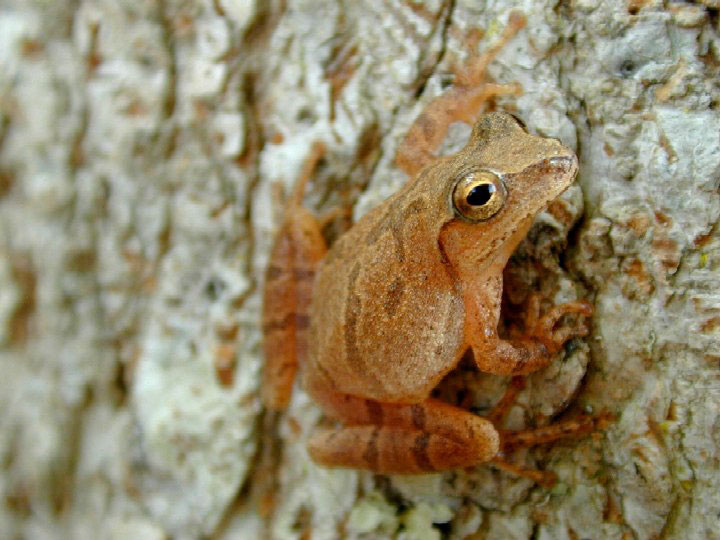
The spring peeper is a small chorus frog widespread throughout the eastern United States and eastern Canada. It prefers permanent ponds due to its advantage in avoiding predation; however, it is very adaptable with respect to the habitat it can live in. In northern regions, the frog is able to endure below freezing temperatures due to the capacity of its liver to exude and flush the bloodstream with a glucose cryoprotectant which acts both as an anti-freeze in its blood, and allows organs like the heart to enter into a state of protected dormancy. The peeper earned its name from its chirping call, which marks the beginning of spring. Crucifer is derived from the Latin root meaning "cross-bearing", a reference to the cross-like pattern on the spring peeper's dorsal side. Source
Where it is now
In the last 8 weeks this frog or toad was recorded 94,120 times across 25 areas (each area is a 5 degree square).
See the Spring Peeper on the live map
Movement and weather
Each season it is first heard regularly where daytime highs are around 25°C (typically 24 to 26°C, from 5 areas).
Over the weeks it was present in the past year, its centre in North America ranged from 19°N in July to 45°N in August, about 2,900 km apart.
Arrival dates
The week it was first heard regularly in each region, after at least six weeks away. Dates differ from south to north, so a region has a range.
| Region | First arrival | Last arrival | Typical peak | Areas |
|---|---|---|---|---|
| North America | 17 August 2026 | 28 September 2026 | 12 October 2026 | 5 |
Figures are effort corrected and come from automatic sound identification, which makes mistakes. How this is measured and how it compares with human observers.