Common Loon
Gavia immer
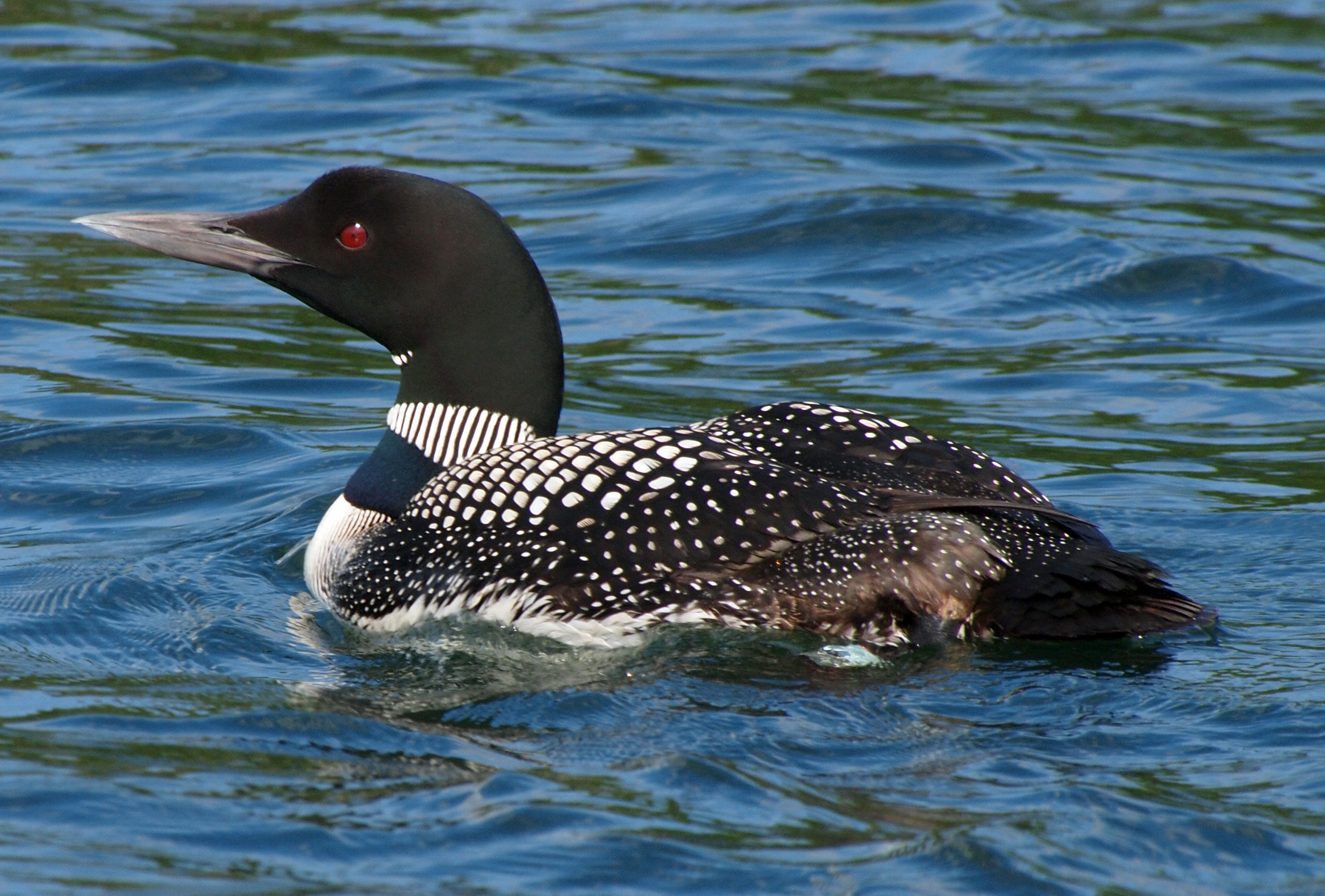
The common loon or great northern diver is a large member of the loon, or diver, family of birds. Breeding adults have a plumage that includes a broad black head and neck with a greenish, purplish, or bluish sheen, blackish or blackish-grey upperparts, and pure white underparts except some black on the undertail coverts and vent. Non-breeding adults are brownish with a dark neck and head marked with dark grey-brown. Their upperparts are dark brownish-grey with an unclear pattern of squares on the shoulders, and the underparts, lower face, chin, and throat are whitish. The sexes look alike, though males are significantly heavier than females. During the breeding season, loons live on lakes and other waterways in Canada, the northern United States, and southern parts of Greenland and Iceland. Small numbers breed on Svalbard and sporadically elsewhere in Arctic Eurasia. Common loons winter on both coasts of North America as far north as Newfoundland and Alaska, and as far south as Mexico, as well as on the Atlantic coast of Europe. Source
Where it is now
In the last 8 weeks this bird was recorded 195,891 times across 96 areas (each area is a 5 degree square).
See the Common Loon on the live map
Movement and weather
Each season it is first heard regularly where daytime highs are around 12°C (typically 6 to 22°C, from 36 areas). That range is wide, so temperature alone does not explain when it turns up.
Over the weeks it was present in the past year, its centre in North America ranged from 41°N in December to 56°N in June, about 1,600 km apart.
Arrival dates
The week it was first heard regularly in each region, after at least six weeks away. Dates differ from south to north, so a region has a range.
| Region | First arrival | Last arrival | Typical peak | Areas |
|---|---|---|---|---|
| North America | 16 March 2026 | 5 October 2026 | 17 August 2026 | 33 |
| Europe | 22 December 2025 | 21 September 2026 | 10 August 2026 | 3 |
Figures are effort corrected and come from automatic sound identification, which makes mistakes. How this is measured and how it compares with human observers.