Black Vulture
Coragyps atratus
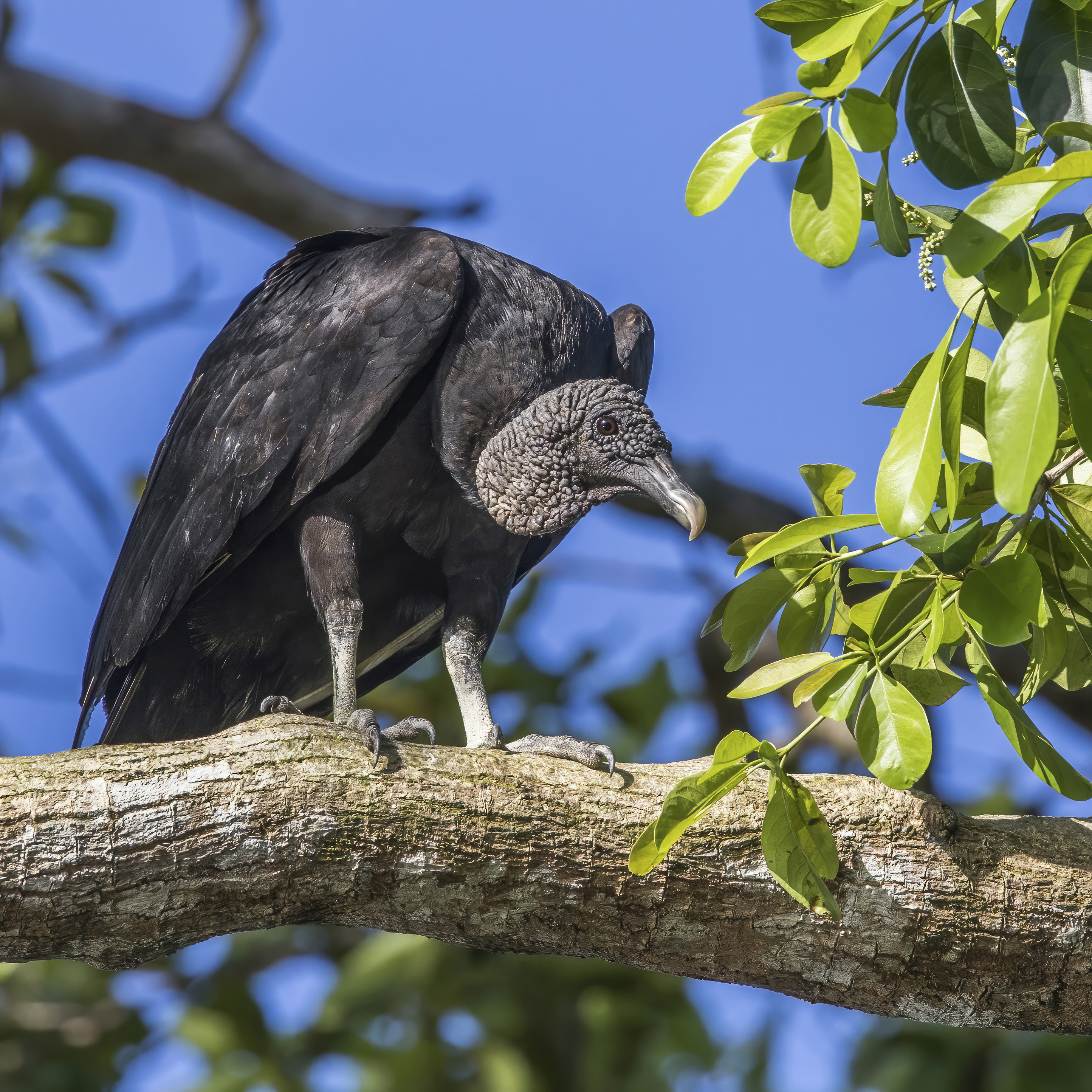
The black vulture, also known as the American black vulture, Mexican vulture, zopilote, urubu, or gallinazo, is a bird in the New World vulture family whose range extends from the northeastern United States to Peru, Central Chile and Uruguay in South America, and common throughout Brazil where it can be seen in large scavenging groups. Although a common and widespread species, it has a somewhat more restricted distribution than its compatriot, the turkey vulture, which breeds well into Canada and all the way south to Tierra del Fuego. It is the only extant member of the genus Coragyps, which is in the family Cathartidae. Despite the similar name and appearance, this species is not closely related to the Eurasian black vulture, an Old World vulture, of the family Accipitridae. For ease of locating animal corpses, black vultures tend to inhabit relatively open areas with scattered trees, such as chaparral, in addition to subtropical forested areas and parts of the Brazilian pantanal. Source
Where it is now
In the last 8 weeks this bird was recorded 3,470 times across 32 areas (each area is a 5 degree square).
See the Black Vulture on the live map
Movement and weather
Each season it is first heard regularly where daytime highs are around 27°C (typically 25 to 32°C, from 6 areas).
Arrival dates
The week it was first heard regularly in each region, after at least six weeks away. Dates differ from south to north, so a region has a range.
| Region | First arrival | Last arrival | Typical peak | Areas |
|---|---|---|---|---|
| North America | 23 February 2026 | 10 August 2026 | 20 July 2026 | 6 |
Figures are effort corrected and come from automatic sound identification, which makes mistakes. How this is measured and how it compares with human observers.