Yellow-tailed Black-Cockatoo
Calyptorhynchus funereus
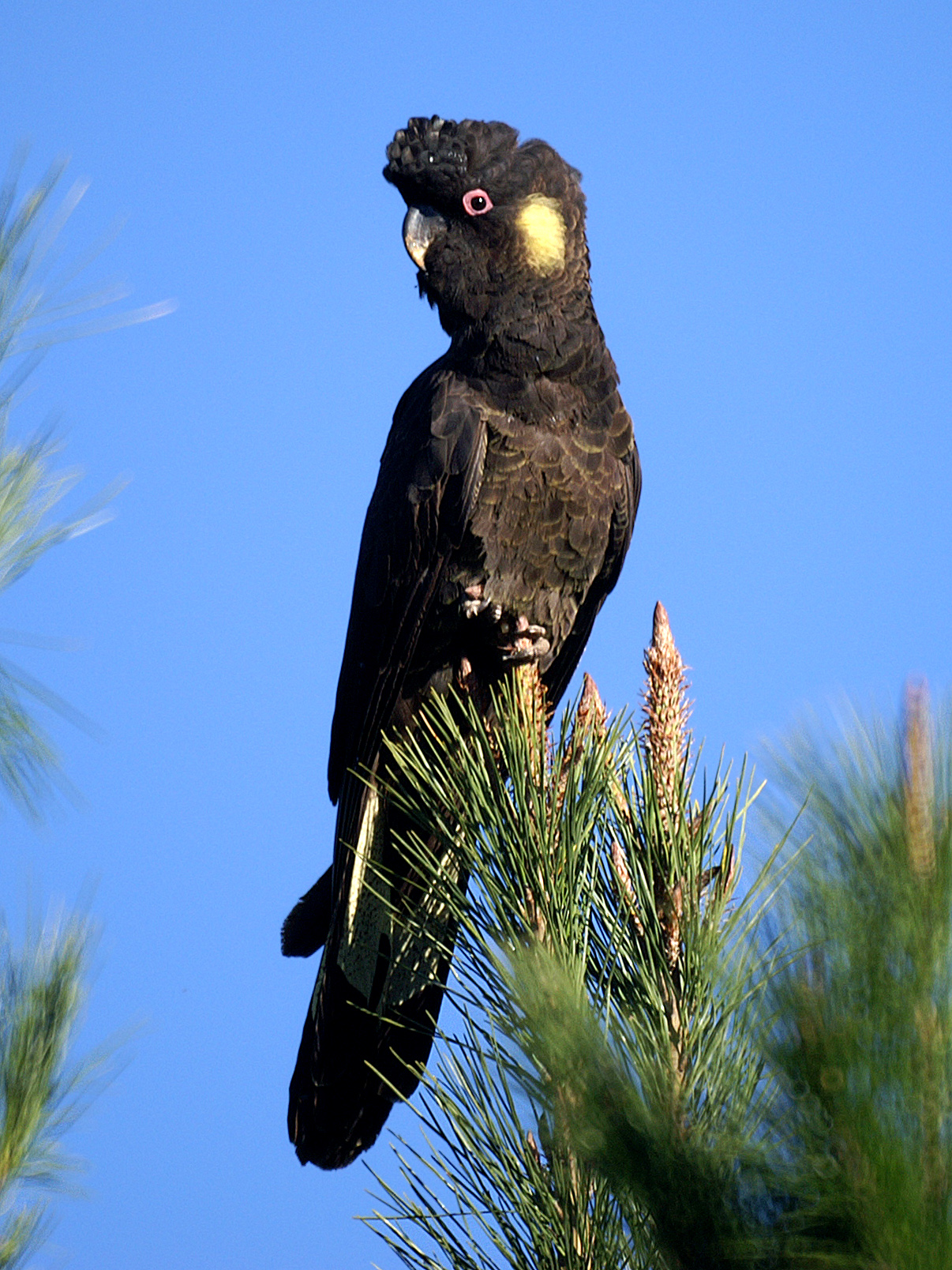
The yellow-tailed black cockatoo is a large cockatoo native to the south-east of Australia measuring 55–65 cm (22–26 in) in length. It has a short crest on the top of its head. Its plumage is mostly brownish black and it has prominent yellow cheek patches and a yellow tail band. The body feathers are edged with yellow giving a scalloped appearance. The adult male has a black beak and pinkish-red eye-rings, and the female has a bone-coloured beak and grey eye-rings. In flight, yellow-tailed black cockatoos flap deeply and slowly, with a peculiar heavy fluid motion. Their loud, wailing calls carry for long distances. The yellow-tailed black cockatoo is found in temperate forests and forested areas across south and central eastern Queensland to southeastern South Australia, including a very small population persisting in the Eyre Peninsula. Two subspecies are recognised, although Tasmanian and southern mainland populations of the southern subspecies xanthanotus may be distinct enough from each other to bring the total to three. Birds of subspecies funereus have longer wings and tails and darker plumage overall, while those of xanthanotus have more prominent scalloping. The subspecies whiteae is found south of Victoria to the East of South Australia and is smaller in size. Source
Where it is now
In the last 8 weeks this bird was recorded 93,528 times across 12 areas (each area is a 5 degree square).
See the Yellow-tailed Black-Cockatoo on the live map
Arrival dates
The week it was first heard regularly in each region, after at least six weeks away. Dates differ from south to north, so a region has a range.
| Region | First arrival | Last arrival | Typical peak | Areas |
|---|---|---|---|---|
| Oceania | 17 November 2025 | 17 November 2025 | 4 May 2026 | 1 |
Figures are effort corrected and come from automatic sound identification, which makes mistakes. How this is measured and how it compares with human observers.